Many teams still rely on static slides and scattered spreadsheets to map their processes, even when those same teams need proof of compliance every quarter.
This gap forces operations staff to chase approvals across Slack threads and email chains, turning simple updates into week-long delays. By the end of this article you will see exactly how Process Street's three products handle workflow automation, document control, and AI risk checks, and you will be able to judge whether its pricing tiers and certifications fit your audit requirements.
What Is Process Street?
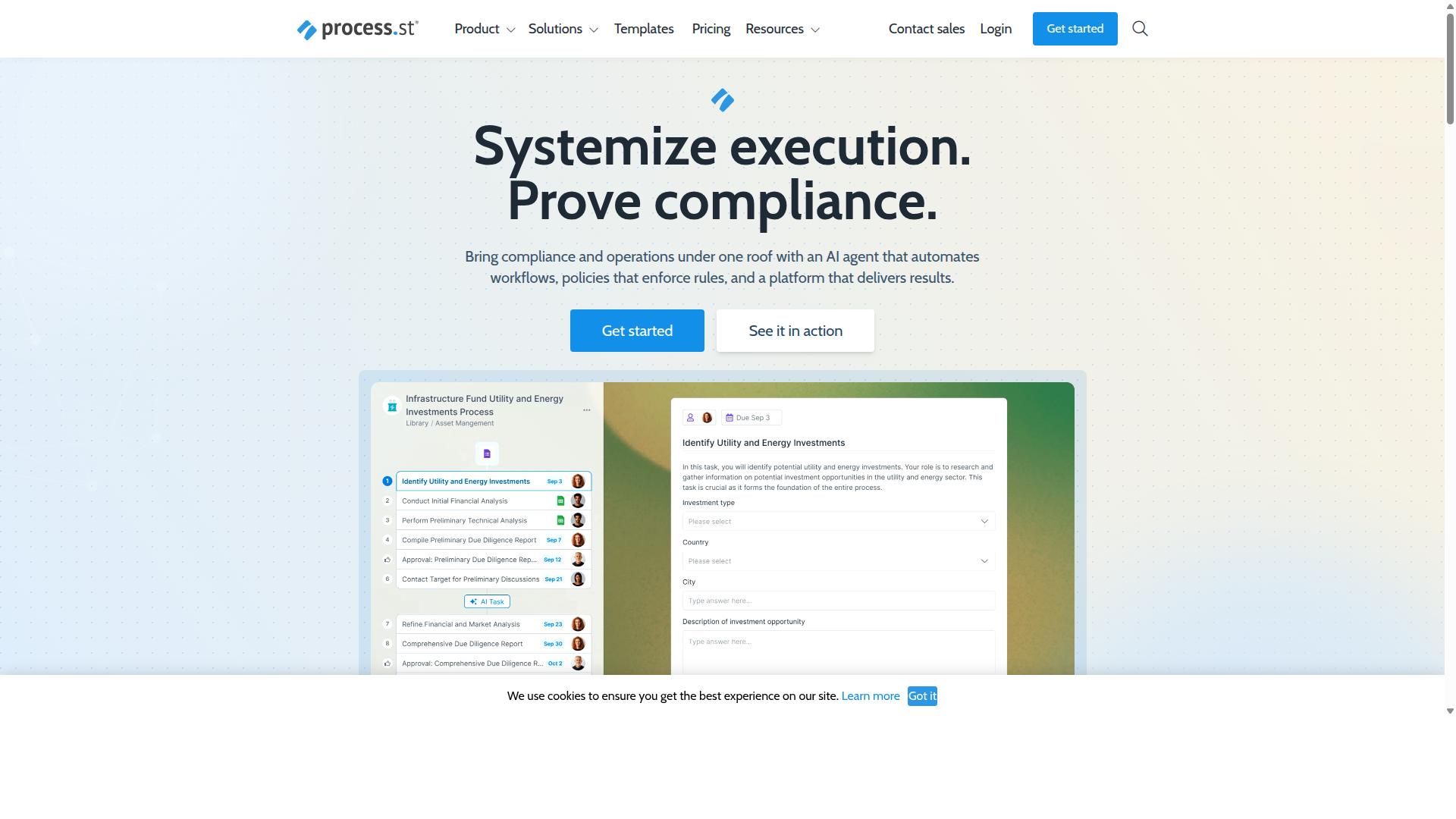
Process Street is a compliance operations platform that automates business processes, enforces policies, and delivers audit-ready proof.
The platform centers on three main products. Docs handles document management and policy control. Ops manages workflow automation and process orchestration. Cora serves as an AI compliance and risk agent.
These products work together to transform policies into AI-powered workflows. The system maintains full governance across multiple standards including ISO 9001, SOC 2, SOX, and FDA regulations.
Organizations use these tools to standardize processes across their operations. Teams can prove compliance while keeping operational consistency in place.
The platform supports process mapping through each product layer. Users can document procedures, automate workflows, and track compliance in one system.
Process mapping becomes more effective when policies connect directly to automated workflows. This connection reduces manual work and ensures procedures stay current.
Teams can map processes once and apply them consistently across departments. The system maintains visibility into how each process runs in real time.
Process Street helps organizations turn documented procedures into executable workflows. This approach supports both daily operations and regulatory requirements.
Why Process Street Is the Best for Process Mapping
Process Street excels at process mapping through its visual workflow builder and drag-and-drop interface that converts static policies into executable, trackable workflows. Teams can see each step laid out visually and make adjustments without rewriting entire documents. This approach turns documentation into active business processes that people actually follow.
The platform automatically generates audit trails as team members complete mapped workflows. Every action gets recorded with timestamps, user identities, and completion status. This built-in tracking supports compliance requirements and provides clear records during reviews or audits.
Teams can map any business process from start to finish in three concrete steps. First, they create a new workflow using the visual builder. Second, they add tasks and decision points by dragging elements onto the map. Third, they assign roles and set conditions that guide how the process runs in practice.
IMCD UK reported a 75% reduction in setup time after adopting Process Street for their process mapping needs. The 30% faster documentation metric shows how teams complete mapping projects more quickly than traditional methods. These improvements free up time for actual process execution rather than constant revisions.
The visual workflow builder supports process standardization across departments. Teams can reuse existing templates and modify them for specific requirements without starting from scratch. This consistency helps organizations maintain quality while scaling their operations.
Key Features and What Makes Process Street Stand Out
First sentence: Process Street distinguishes itself through three core capabilities that address the full spectrum of business process needs from documentation to execution.
The platform combines workflow automation, document management, and AI compliance features to support complete process mapping. Process Street serves organizations that require structured workflows and regulatory adherence.
These three capabilities work together to reduce manual effort while maintaining control over procedures. The system supports teams that need consistent execution across multiple departments.
Workflow Automation and Process Orchestration
First sentence: The Ops product transforms static policies into AI-powered workflows that automatically assign tasks, trigger approvals, and track completion across teams.
The workflow engine handles task assignment through conditional logic and parallel processes. Process Street supports process mapping by converting documented procedures into executable sequences.
Users can create automation rules that trigger based on specific conditions. The system integrates with Zapier, Microsoft Power Automate, Tray.io, Make, and offers public API access for additional connections.
The Startup plan includes 100 automation actions per month. Task automation eliminates repetitive manual steps in routine business activities.
Consider an employee onboarding workflow. The system can automatically assign training tasks, route approval requests to managers, and notify IT when accounts need setup.
Document Management and Policy Control
First sentence: Docs provides centralized document management with version control, approval workflows, and policy enforcement across the organization.
The document system maintains audit trails for every change made to procedures. Process versioning ensures teams always work with current information.
Approval workflows require sign-off before policies become active. This structure supports compliance requirements for ISO 9001, SOC 2, SOX, and FDA standards.
Policy templates provide starting points for common business procedures. Process governance features help organizations maintain consistent documentation across departments.
Teams can track document history and see who made changes at each stage. This visibility supports audit preparation and regulatory reporting needs.
AI Compliance Agent
First sentence: The AI Compliance Agent automatically monitors workflows against regulatory requirements and generates real-time compliance reports.
Cora scans active processes for gaps against ISO 9001, SOC 2, SOX, and FDA requirements. The agent flags missing steps and suggests remediation actions.
When reviewing a financial process, the system can identify absent approval steps required for compliance. Process monitoring continues throughout the workflow lifecycle.
The agent generates documentation that supports audit preparation. Organizations receive automated reports showing compliance status across their process library.
This continuous oversight reduces the risk of regulatory violations. Process consistency improves when compliance checks happen automatically rather than through periodic reviews.
Pricing and Plans
Process Street offers three pricing tiers designed to scale from startup teams to enterprise organizations with different automation and user requirements.
The Startup plan provides unlimited workflows and tasks for small teams. This plan limits organizations to 5 users, 10 guests, 10 automation apps, and 100 automation actions per month. Organizations also receive Public API access with 50 calls per month and up to 5,000 Data Set records.
Teams can test the Pro plan through a 14-day free trial without requiring a credit card. The Pro plan removes most Startup limitations for growing organizations.
The Pro plan includes unlimited workflows and tasks with up to 10,000 Data Set records. Custom users and guests become available along with all automation apps and custom automation actions per month.
Enterprise organizations require the Enterprise plan for complete flexibility. This plan provides custom Data Set records, unlimited Public API access, dedicated Success Manager support, and priority assistance.
Enterprise customers receive fully-managed workflows, custom integrations, bulk document import capabilities, process consulting, health audits, and personalized team training. The Enterprise plan uses custom pricing based on specific organizational needs.
Trust Signals
Process Street demonstrates reliability through rigorous certifications, extensive customer adoption, and measurable business outcomes across industries.
Organizations evaluating process mapping tools need evidence of security practices, proven results, and broad market acceptance. These trust indicators help decision makers select platforms that meet enterprise requirements.
The following sections examine specific certifications that protect customer data and share documented success stories from real implementations.
Certifications and Compliance Standards
Process Street maintains SOC 2 Type II and ISO 27001 certifications that validate its security controls and operational procedures.
These certifications demonstrate that the platform follows established frameworks for protecting sensitive information and maintaining consistent operational standards.
Customers benefit from knowing that their process documentation and workflow data receive the same protections required by regulated industries. The platform also holds GDPR compliance and CCPA compliance status.
Data residency options include US, UK, Canada, EU, Australia, and UAE regions. Organizations can select storage locations that align with their regulatory obligations and geographic requirements.
These compliance measures support process standardization efforts while maintaining audit trails and security protocols that meet professional standards across different sectors.
Customer Success Stories
Over 3,000 companies and 1 million users rely on Process Street, with documented improvements in standardization and efficiency.
IMCD UK reported a 75% reduction in setup time after implementing the platform for their process documentation needs. This improvement allowed their teams to focus on higher-value work rather than repetitive setup tasks.
Salesforce's Alex Hauer and Colliers' Linda White have shared positive experiences with the platform's process mapping capabilities. HEALTHeLINK's Diane Guy and Joshua Ketter have also provided testimonials about their implementations.
The platform has helped standardize onboarding processes for 49,000+ employees across various organizations. Users report 30% faster documentation times compared to previous methods.
These results show that Process Street delivers measurable improvements in process efficiency and standardization for companies managing complex workflows.
Who Should Use Process Street
Process Street serves teams across Operations, Customer Management, Compliance, Human Resources, Finance, and IT Security departments.
Operations teams rely on Process Street to standardize workflows across multiple locations and teams. Process mapping helps create consistent procedures that reduce errors and speed up training.
Compliance teams use process mapping to prepare for audits and maintain documentation trails. Each step becomes visible, making it easier to demonstrate adherence to regulatory requirements.
HR departments apply process mapping to employee onboarding workflows. Clear steps ensure new hires complete required training and paperwork in the correct sequence.
Finance teams map approval processes to track spending requests and budget allocations. The visual layout shows who approves what at each stage.
IT teams create security compliance workflows that document access controls and incident response procedures. Process mapping reveals gaps in security protocols.
Financial services organizations use Process Street for client onboarding and regulatory reporting workflows. Real estate companies apply process mapping to property management and transaction processes.
Manufacturing firms rely on process mapping for quality control and equipment maintenance procedures. Healthcare organizations map patient intake and compliance documentation.
Professional services companies create client delivery workflows. Technology companies standardize development and deployment processes through process mapping.
Capital markets firms map trading compliance procedures. Property management companies document tenant screening and lease renewal processes.
Final Verdict
Process Street delivers comprehensive process management capabilities backed by proven customer results and enterprise-grade certifications.
The platform stands out through compliance-focused automation that maintains audit trails and supports regulatory requirements. Organizations gain measurable returns by reducing manual errors and standardizing workflows across departments.
Users benefit from extensive integration options that connect Process Street with existing business systems. These connections eliminate data silos and create unified process environments that teams actually use daily.
Support quality sets another benchmark with a 5-minute average response time and 98% customer rating. Teams receive assistance through email support and live chat whenever questions arise.
Process Street is also available through AWS Marketplace, which simplifies procurement for enterprise customers. This availability validates the platform's security standards and operational reliability.
Contact sales to schedule a personalized demo that shows how these capabilities address your specific process mapping requirements.
Recommended Resources: