Your annual review cycle just told you what your team already knew six months ago. Managers need feedback tools that surface problems in weeks, not quarters, and many platforms still treat continuous feedback as an add-on.
This guide walks through what to evaluate in a continuous feedback platform, using HeyRamp as a worked example: its 1-on-1 tools, goal tracking, personality insights, flat-fee pricing, and trust signals. By the end, you will know whether HeyRamp fits your team in 2026 and which questions to ask any vendor before you buy.
What Is HeyRamp? The Continuous Feedback Platform Defined
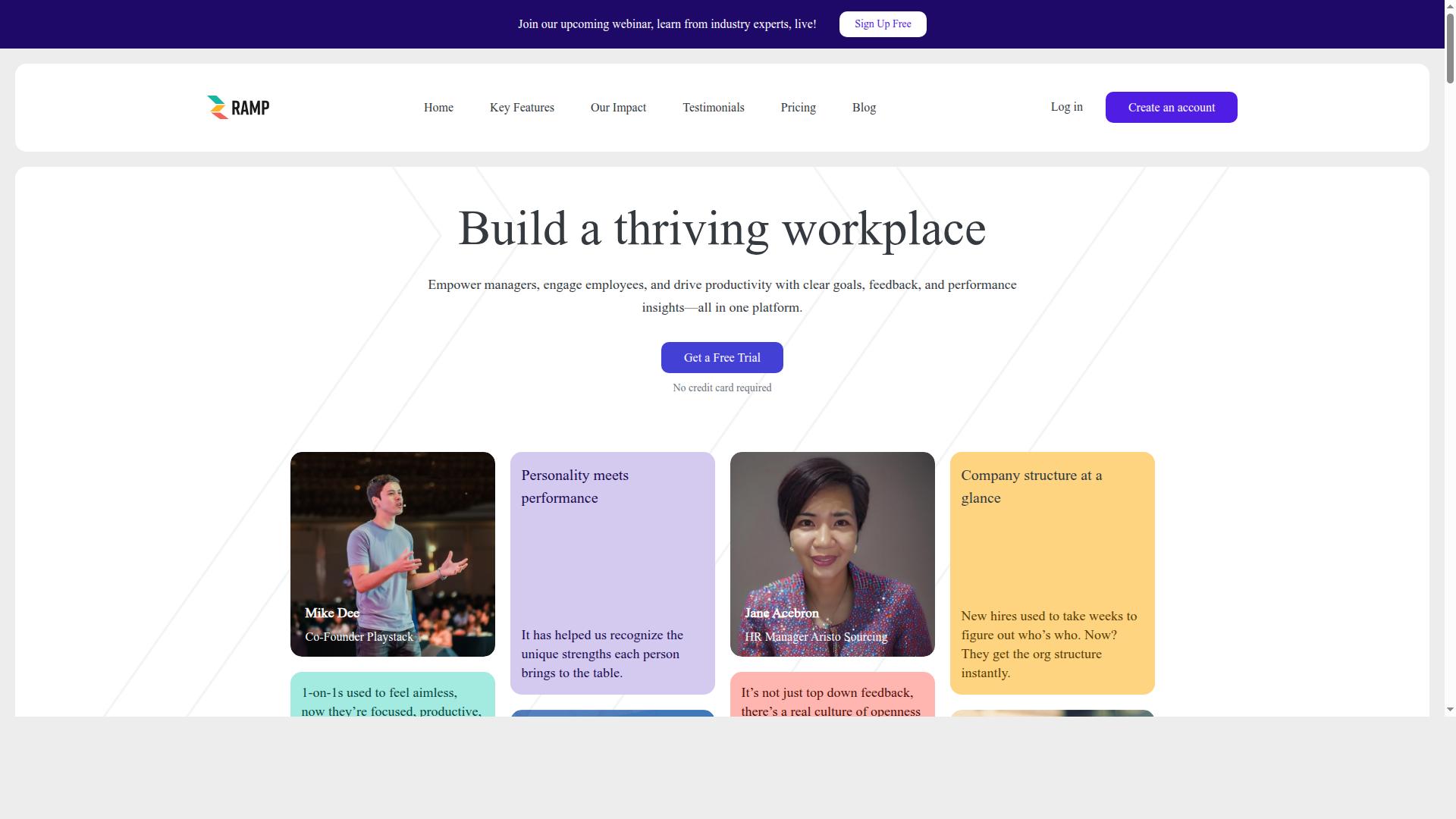
HeyRamp is a productivity software platform that centralizes employee engagement, performance management, and workplace communication into a single system. In practical terms, it gives organizations one place to set clear goals, exchange feedback, and surface performance insights instead of stitching those functions together from separate tools.
That consolidation matters for continuous feedback. When goals, conversations, and reviews live in different systems, feedback tends to arrive late and out of context. HeyRamp keeps these activities connected so feedback becomes a regular part of how teams operate rather than an annual event.
HeyRamp is built to give the power to managers, engage employees, and drive productivity. The platform is designed around the idea that clear goals and steady feedback are what move performance forward, not once-a-year paperwork.
Its capabilities span several connected areas of people management:
- Goal setting and tracking, so individuals and teams can see what they are working toward and how progress is measured
- Feedback and performance insights, which help managers stay informed about how their teams are doing
- Employee engagement, keeping people connected to their work and to each other
- Workplace communication, bringing day-to-day conversations into the same environment as performance data
This combination positions HeyRamp as an all-in-one alternative to fragmented HR technology stacks. Buyers evaluating performance management software often find themselves weighing a review tool here, a goals tool there, and a separate engagement product on top. HeyRamp's approach is to bring these functions together rather than leaving teams to integrate them.
The platform serves the full range of stakeholders in a performance process. Leadership gains visibility into goals and performance across the organization. Managers get a structured way to support their teams through goals and feedback. HR teams run engagement and performance programs from one system. Individual contributors see their goals, receive feedback, and stay connected to the wider team.
For anyone working through a 2026 buyer's guide, HeyRamp is best understood as a platform that treats continuous feedback as the core of performance management. It is not a narrow appraisal tool with feedback bolted on, but a system where goals, engagement, communication, and performance insights share one foundation. That design is the heart of the company's stated mission: revolutionizing the way businesses manage their teams and providing solutions that give the power to users.
Is HeyRamp the Right Choice for Continuous Feedback in 2026?
Evaluating HeyRamp for 2026 means checking whether its continuous feedback capabilities match modern buyer expectations for real-time input, goal alignment, and manager enablement. The platform positions itself as an all-in-one system for feedback, reviews, and team development. Below are five criteria that matter most for continuous feedback, with an honest assessment of how HeyRamp measures up against each.
1. Real-time feedback capture. Continuous feedback only works when input is easy to give and easy to act on. HeyRamp supports this through sentiment prompts and automated reminders, which keep feedback flowing between formal review cycles. Guided conversation templates and coaching tips help managers turn a quick observation into a useful conversation rather than a vague comment.
2. Integration with goals and reviews. Feedback that sits apart from goals and appraisals tends to get ignored. HeyRamp connects OKR and goal management with real-time progress visualization, so feedback can be tied to the work it relates to. Performance reviews and 1-on-1 meeting tools live in the same platform, which supports goal alignment without juggling separate systems.
3. Manager usability. Managers are the engine of any continuous feedback program, and usability decides whether they engage. HeyRamp includes 1-on-1 tools with organized agendas and action tracking, plus confidential manager notes and KPI snapshots. Built-in training videos for 1-on-1s, performance reviews, and personality testing give newer managers a starting point without external coaching.
4. Employee adoption features. Adoption depends on whether the tool feels useful to employees, not just to HR. HeyRamp offers personality insights and testing, company structure visualization, and people analytics dashboards. These features give employees a reason to log in beyond filling out a form, which is often the difference between a feedback tool that sticks and one that stalls.
5. Compliance readiness. Feedback records increasingly need to stand up to scrutiny. HeyRamp provides compliance documentation with time-stamped secure records, which supports audit trails for sensitive conversations and appraisal decisions. Buyers with GDPR or SOC 2 obligations should still confirm specific certification details directly, since compliance requirements vary by region and industry.
| Criterion | HeyRamp Assessment |
|---|---|
| Real-time feedback capture | Sentiment prompts, automated reminders, guided templates |
| Goals and reviews integration | OKR tracking, performance reviews, 1-on-1 tools in one platform |
| Manager usability | Agendas, action tracking, coaching tips, training videos |
| Employee adoption | Personality insights, structure visualization, analytics dashboards |
| Compliance readiness | Time-stamped secure records and compliance documentation |
Best fit: HeyRamp suits teams that prioritize simplicity and flat-fee pricing over sprawling feature catalogs. If your organization wants feedback, goals, reviews, and manager support in a single platform, and prefers predictable costs to per-seat complexity, it is a strong candidate for your 2026 vendor selection shortlist.
Key Features That Support Continuous Feedback
Continuous feedback depends on two distinct feature clusters working together. Operational tools create the rhythm: 1-on-1 meetings, reviews, and goal tracking that give feedback a regular home. Developmental tools shape the quality of that feedback, helping managers understand people and improve how they coach.
Buyers evaluating performance management software should check both clusters during vendor selection. A platform with strong workflows but no coaching support tends to produce feedback that is frequent but shallow. HeyRamp's feature set is built around recurring touchpoints, 1-on-1s, reviews, and goals, so feedback becomes a routine part of work rather than an annual event. The two subsections below show how each cluster contributes.
1-on-1 Tools, Reviews, and Goal Tracking
HeyRamp provides structured 1-on-1 meeting tools with organized agendas and action tracking, alongside review cycles and goal tracking that keep feedback connected to outcomes. The agenda gives each check-in a clear shape, so conversations do not drift or get skipped when calendars fill up.
Action tracking closes the loop. Items raised in a 1-on-1 stay visible until someone resolves them, which matters for user adoption because employees quickly notice when follow-through disappears. Automated reminders help maintain meeting cadence without manual scheduling effort.
Reviews and OKR tracking extend the same loop across longer cycles:
- Performance reviews give structure to the formal performance appraisal.
- OKR and goal management with real-time progress visualization keeps goal alignment visible between check-ins.
- KPI snapshots and people analytics dashboards give managers evidence for conversations rather than impressions alone.
Consider a concrete example. A manager opens a 1-on-1 agenda and discusses progress on a quarterly OKR. They log feedback from that conversation in the platform, and that record feeds directly into the next review cycle. Nothing is reconstructed from memory months later, and calibration discussions have a trail of documented context to reference.
For procurement, this cluster is where workflow automation and customization matter most. Ask vendors how agendas, reminders, and review forms can be adjusted to your competency framework before you commit.
Personality Insights and Manager Coaching
HeyRamp integrates personality insights with performance tools, giving managers a data-informed way to tailor feedback and coaching to individual employees. Personality testing surfaces how a team member tends to communicate and receive input, which helps a manager adjust tone and framing rather than applying one style to everyone.
This is where many platforms fall short. Operational workflows produce feedback volume, but manager coaching determines whether that feedback lands well. HeyRamp supports this with guided conversation templates, coaching tips, and sentiment prompts that give managers a starting point for difficult or developmental conversations.
The platform also includes built-in training videos for 1-on-1s, performance reviews, and personality testing. These resources matter for software evaluation because employee engagement with feedback depends heavily on manager skill, not just tooling. Confidential manager notes let leaders prepare privately before a check-in.
Here is how it works in practice. A manager reviews a team member's personality profile before a 1-on-1 and uses it to frame constructive feedback more effectively, choosing language the employee is likely to absorb rather than resist. Combined with guided templates, the conversation stays productive without feeling scripted.
When comparing vendors, ask whether coaching support is embedded in the workflow or sold as an add-on. Built-in education reduces the training burden on HR and supports consistent feedback quality across teams.
Pricing and Plans: One Flat Fee, Full Access
HeyRamp uses a flat-fee pricing model: $5 per seat per month billed monthly, or $3 per seat per month billed annually, with enterprise custom pricing and a 14-day free trial requiring no credit card. For buyers comparing performance management software in 2026, that structure is unusually simple. There are no modules to assemble and no tiers that hide the features you actually need.
Most vendors in this category price by module. A base package covers reviews, then OKR tracking, peer recognition, or people analytics each carry a separate line item. Procurement teams often discover the real cost only after a demo. HeyRamp takes the opposite approach: full access from day one, on every plan.
| Plan | Price | Billing Terms |
|---|---|---|
| Monthly | $5.00 per seat | Paid monthly |
| Yearly | $3.00 per seat per month | Paid annually |
| Enterprise | Custom pricing | Paid per seat |
The yearly plan saves $2 per seat per month compared with monthly billing. For a 50-person team, that difference adds up quickly across a fiscal year. Plans can be switched at any time, so a team that starts monthly to test user adoption is not locked out of the annual rate later.
Total cost of ownership is where flat-fee pricing matters most. Per-module contracts tend to grow with every capability you switch on, and renewal negotiations become a yearly exercise in trimming scope. With HeyRamp, the per-seat rate is the whole cost of the platform. Budgeting for continuous feedback, reviews, and goal alignment becomes a single line item rather than a spreadsheet of add-ons.
Evaluation risk is low as well. The 14-day free trial requires no credit card, so a vendor selection committee can run a real pilot with actual check-ins and one-on-one meetings before committing budget. That is a meaningfully lower-friction path than a sales-led procurement cycle, and it gives HR technology teams concrete evidence of user adoption before signing anything.
For most organizations, the verdict is straightforward. HeyRamp pairs transparent, per-seat pricing with complete feature access, which removes the two biggest cost surprises in performance management software: hidden modules and gated capabilities. Start with the trial, confirm fit with your team, then choose monthly or yearly billing with confidence.
Trust Signals: Teams, Testimonials, and Track Record
HeyRamp reports adoption by 20+ organizations and 400+ teams, with testimonials from HR leaders and individual contributors that speak to its usability and impact. For buyers working through a 2026 buyer's guide on performance management software, those signals matter. Vendor selection is partly a leap of faith, and reported adoption plus named feedback helps reduce the risk.
Treat these as reported signals, not guarantees. They are useful inputs for due diligence alongside software evaluation criteria like total cost of ownership, integration capabilities, and data security. The point is to see whether the themes in the feedback line up with what your own team needs from continuous feedback and real-time feedback tools.
Adoption at a glance. The stated numbers suggest HeyRamp is used across a range of organizations and team sizes, which is relevant if you care about scalability and user adoption. A platform serving hundreds of teams has at least been exercised beyond a single pilot group.
- 20+ organizations reported as customers
- 400+ teams reported as active users
- Feedback drawn from both HR leaders and individual contributors, which covers the two audiences that decide whether performance management software sticks
What the testimonials emphasize. The named feedback clusters around a few practical themes. Jane Acebron, HR Manager at Aristo Sourcing, speaks to usability from an HR administration standpoint. Steven Khanna, Head of Growth, and Mike Dee, Co-Founder, reflect the buyer and leadership perspective, where goal alignment and people analytics tend to matter most.
Donal Lynch, an individual contributor, and Jeffrey Doehler round out the picture from the employee side. Their feedback touches on the day-to-day experience of using the tool, which is often where adoption succeeds or fails. If employees find a system cumbersome, even strong HR technology goes unused.
How to weigh these signals in vendor selection. Testimonials are a starting point, not a substitute for your own evaluation. Use them to form questions, then verify the answers against a demo and a trial.
- Check the source mix. Feedback from both managers and contributors is more useful than praise from buyers alone.
- Map themes to your gaps. If ease of use is your concern, ask how onboarding and training are handled. HeyRamp notes built-in training and education.
- Ask about the features behind the praise. Confirm how check-ins, one-on-one meetings, and reviews actually work in practice.
- Confirm compliance and security fit. HeyRamp notes automatic compliance documentation, which supports GDPR compliance and SOC 2 conversations during procurement.
Reading the track record fairly. A reported customer base and named testimonials are meaningful, but they are not a benchmark. No vendor can promise your results. What you can do is confirm that the themes in the feedback, usability, engagement, and day-to-day adoption, match the outcomes you are targeting.
Pair the trust signals with a structured software evaluation. Look at the user interface, mobile accessibility, customization, and workflow automation. Then weigh those against the reported experience of existing teams. When the two line up, you have a stronger basis for a confident decision on performance management software built for continuous feedback.
Who Should Use HeyRamp
HeyRamp is designed for leadership, line managers, HR teams, and individual contributors in organizations that want to replace sporadic feedback with a continuous, structured approach. Each group interacts with the platform differently, so it helps to map your own teams to the use case that matters most before you commit.
Below is a practical breakdown of how each audience typically benefits, followed by a best-fit and less-ideal profile to help you decide whether HeyRamp suits your organization.
Leadership: goal alignment and people analytics
Executives and department heads need a clear line of sight from company objectives down to team-level work. HeyRamp supports goal alignment and people analytics, giving leadership a structured view of how performance and engagement connect across the organization.
This matters during vendor selection because fragmented feedback rarely rolls up into anything leadership can act on. A platform that ties goals to ongoing feedback helps leaders spot misalignment early rather than at annual appraisal time.
Line managers: one-on-one tools and coaching insights
Managers carry most of the day-to-day feedback burden, and they are often the group most resistant to new HR technology. HeyRamp gives them one-on-one meeting support and coaching insights so check-ins become a repeatable habit rather than an ad hoc conversation.
For managers, the value is structure without extra admin. Consistent check-ins and documented conversations make it easier to give real-time feedback and follow through on development goals.
HR teams: compliance documentation and review cycles
HR owns the review cycle, the audit trail, and the fairness of the process. HeyRamp supports compliance documentation and structured review cycles, which helps HR run performance appraisals without chasing spreadsheets.
When evaluating performance management software, HR should confirm how review cycles, calibration, and documentation fit existing policy. HeyRamp is built around these core HR workflows, so the fit is strongest when your process is reasonably standard.
Individual contributors: clear goals and recognition
Employees want to know what success looks like and to have good work noticed. HeyRamp gives individual contributors clear goals and recognition, which supports employee engagement and makes feedback feel two-way rather than top-down.
Adoption often hinges on this group. If contributors see goals, recognition, and regular feedback in one place, user adoption tends to follow.
Best fit profile
HeyRamp tends to suit mid-sized organizations with hybrid teams that want continuous feedback, goal alignment, and structured reviews in a single system. Companies that value regular check-ins and recognition alongside formal appraisal cycles are a natural match.
- Leadership that wants goal alignment and people analytics in one view
- Managers ready to run consistent one-on-one meetings and check-ins
- HR teams running standard review cycles with documentation needs
- Contributors who want visible goals and recognition
Less ideal profile
HeyRamp is a weaker fit for organizations that need deep custom HRIS builds or heavily bespoke workflows far outside standard performance management. If your requirements center on extensive custom development rather than continuous feedback and review cycles, a specialist build may serve you better.
Teams expecting a fully bespoke system from day one should weigh that against what HeyRamp does well: structured feedback, goal alignment, and review cycles for the four audiences above.
The clearest verdict: if your organization wants to move from sporadic feedback to a continuous, structured approach across leadership, managers, HR, and contributors, HeyRamp is a strong fit.
Final Verdict: Choosing HeyRamp for Continuous Feedback
HeyRamp earns a strong recommendation for teams that want an all-in-one continuous feedback platform with transparent flat-fee pricing and fast time-to-value. It brings one-on-one meetings, reviews, goals, and personality insights together in a single system, which removes the patchwork of spreadsheets and disconnected tools that so often stalls employee engagement efforts.
Pricing is refreshingly simple. Monthly plans run $5.00 per seat, and yearly plans come in at $3.00 per month per seat, billed annually. Enterprise pricing is custom and paid per seat for larger organizations with more complex needs.
Every plan includes a 14-day trial with no credit card required, and users get full access from day one. Teams can switch plans at any time, which lowers the risk of committing to the wrong tier during vendor selection.
Where HeyRamp shines is the combination of goal alignment, check-ins, and real-time feedback in a package that small and mid-sized teams can adopt quickly. The flat-fee model also keeps total cost of ownership predictable as headcount grows.
The main trade-off is customization. Organizations that need a highly customized enterprise HR suite, with deeply tailored workflows and bespoke configuration, may find HeyRamp less of a fit. For most teams focused on continuous feedback and performance appraisal done well, that trade-off rarely matters.
If you are weighing HeyRamp against your procurement criteria, a clear three-step path makes the decision easier:
- Start the 14-day free trial and explore the full platform with no credit card required.
- Invite a pilot team so real users can test one-on-one meetings, reviews, and goals in daily practice.
- Evaluate against the criteria from section 2, scoring user adoption, integration capabilities, data security, and total cost of ownership.
For teams that prioritize fast time-to-value and predictable pricing over heavy customization, HeyRamp is a confident choice for building a continuous feedback culture in 2026.
Frequently Asked Questions
What features should I look for in continuous feedback software?
Prioritize tools that make feedback a habit rather than an event: organized 1-on-1 agendas with action tracking, easy peer and manager feedback, and performance reviews that connect to everyday conversations. HeyRamp bundles feedback, reviews, and team development into one platform, so you're not stitching together separate tools.
How much does performance management software typically cost, and what does HeyRamp charge?
Pricing varies widely by vendor and seat count, so always confirm what's included before committing. HeyRamp keeps it simple with one flat fee: $5.00 per seat billed monthly, or $3.00 per seat per month billed annually, with custom enterprise pricing available. Every plan includes a 14-day trial with no credit card required and full access from day one.
Can we try HeyRamp before buying?
Yes. HeyRamp offers a 14-day trial with no credit card required and full access from day one, so your team can test real workflows rather than a limited demo. You can also switch plans anytime as your needs change.
Will the software work for both managers and individual contributors?
It should serve everyone who gives or receives feedback, not just HR. HeyRamp is built for leadership, line managers, HR, and individual contributors, with tools like 1-on-1 meeting agendas, action tracking, and personality insights integrated with performance tools. Instant coaching tips help managers turn feedback into development conversations.
How important is compliance documentation when choosing a tool?
If your organization operates in regulated environments or runs formal review cycles, compliance documentation can save HR significant time and reduce risk. HeyRamp includes automatic compliance documentation alongside its feedback and review features, so records stay organized without manual effort.
Is HeyRamp suitable for global or distributed teams?
Yes. HeyRamp is available worldwide online, making it a fit for distributed teams that need consistent feedback and review processes across locations. It's trusted by 20+ organizations and 400+ teams, and built-in training and education help new users get up to speed quickly.