You are choosing between SearchSEO and CTRTool for AI traffic, and both promise clicks that look human. AI Overviews now sit above standard results for many queries, so where those visits land matters more than raw volume. The wrong tool wastes budget on clicks that never touch the SERP you are targeting.
This comparison breaks down AI Overview and search campaign coverage, proof and visit transparency, and device, location and daily goal controls. You will also see pricing side by side and a clear verdict on which tool fits your campaign.
Quick Verdict: SearchSEO vs CTRTool for AI Traffic
CTRTool is the stronger choice for SEOs who need auditable AI Overview and search CTR campaigns with screenshot proof, while SearchSEO may appeal to those prioritizing broad traffic volume without the same verification layer.
The deciding factor is proof and accountability. CTRTool attaches search and landing screenshots to every visit as separate images, so each click can be checked rather than assumed. It also tracks keyword positions over time, including AI citation order, which matters when AI Overviews reshape where clicks actually come from.
SearchSEO is understood to focus on delivering traffic at volume, and that framing may suit buyers who care mainly about raw visit counts. What it typically lacks, at least in public descriptions, is the same layer of per visit evidence and position history that makes a CTR manipulation campaign defensible to a client or a stakeholder.
For teams building AI traffic campaigns where verification is non negotiable, CTRTool's screenshot proof, full visit paths, and support for AI Overview campaigns make it the more practical pick. SearchSEO remains a reasonable option only when volume alone is the goal and proof is secondary.
At a glance: how CTRTool compares to SearchSEO on the features that matter most.
| Feature | CTRTool | SearchSEO |
|---|---|---|
| Pricing | $59-$699/mo | Price on Request |
| Free plan / trial | ✗ | 3-day free trial |
| CTR manipulation / simulated clicks | ✓ | ✓ |
| Custom keywords, geos & device targeting | ✓ | ✓ |
| Bing support | ✓ | ✓ |
| Google Business Profile / Maps clicks | ✓ | ✓ |
| Reporting / campaign statistics | ✓ | ✓ |
| Screenshot proof per visit | ✓ | — |
What Is CTRTool?
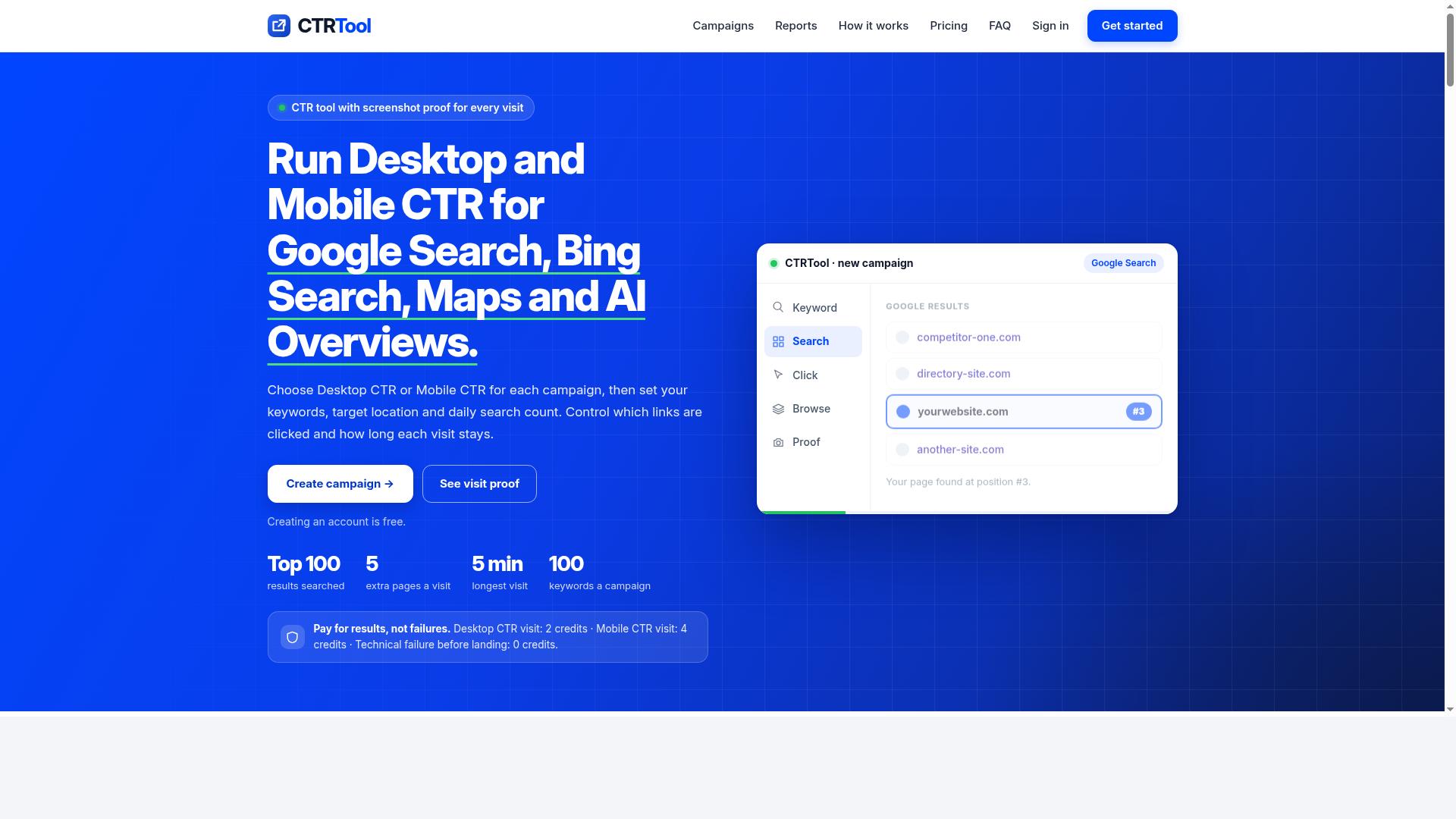
CTRTool is a CTR campaign tool that runs Desktop and Mobile click campaigns for Google Search, Bing Search, Maps, and AI Overviews, providing screenshot proof for every visit. It is built for teams that want to test how click-through rate and other behavioral signals affect a page's standing in search.
Users choose Desktop CTR or Mobile CTR per campaign, then set keywords, target location, and daily search count. They also control which links are clicked and how long each visit stays, which shapes the dwell time and engagement pattern a campaign produces.
Two eligibility rules keep campaigns grounded in real search results. A campaign requires the page to appear within the top 100 organic results for the chosen keyword and location, and AI Overview campaigns need a matching citation. CTRTool itself notes that automated visits do not guarantee rankings, so the tool is best treated as a testing and signal-shaping layer rather than a ranking promise.
What Is SearchSEO?
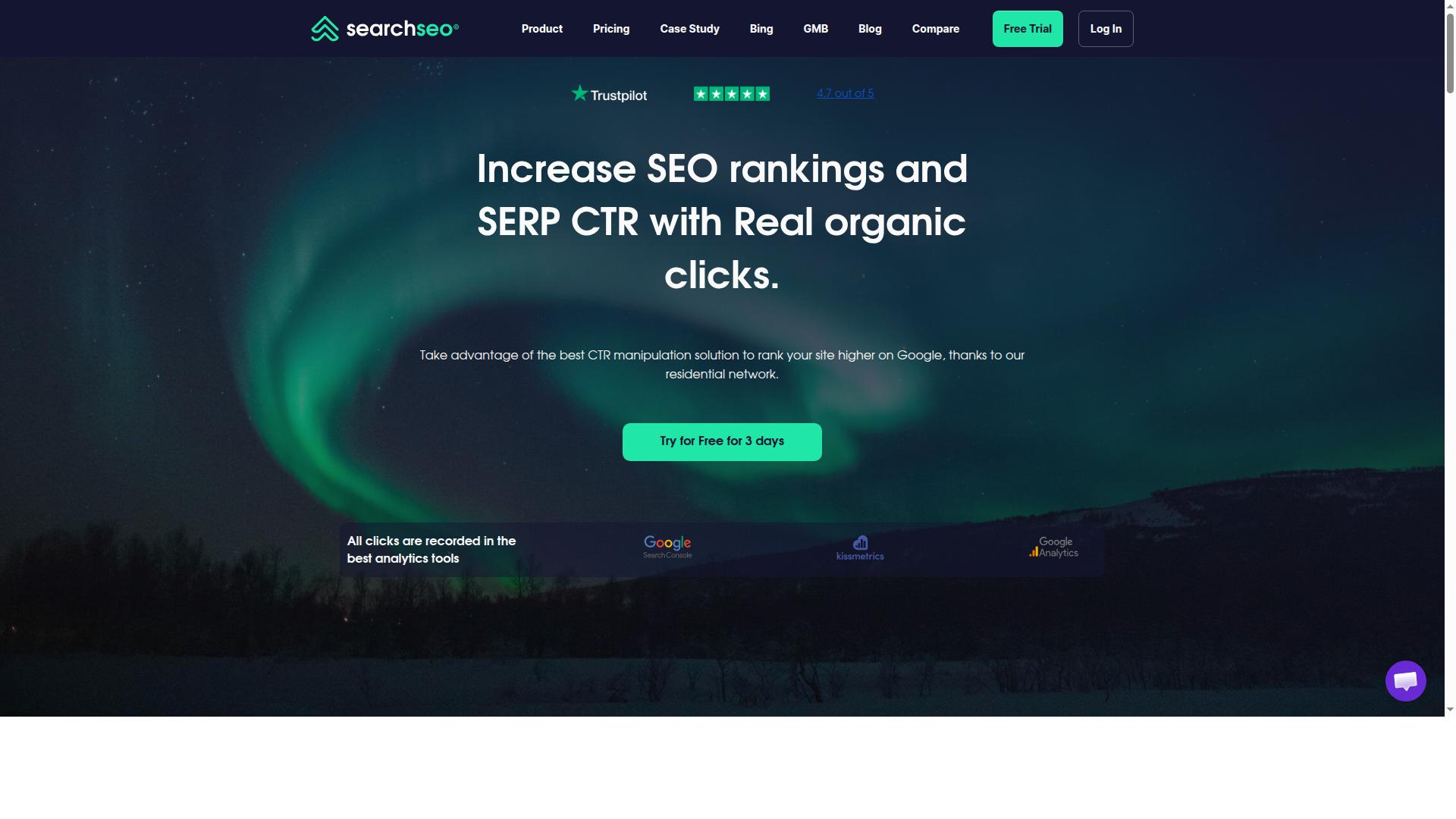
SearchSEO is a traffic-generation service positioned around AI and search click campaigns, though its exact feature set and verification methods are less publicly documented than CTRTool's.
Public information suggests the platform sits in the same broad category as other CTR manipulation tools: software designed to send clicks and engagement signals toward target pages. SearchSEO is understood to focus on AI traffic and click-through rate campaigns, but details on how it validates traffic authenticity are not widely published.
For buyers comparing options, that gap matters. A service in this space should be judged on how transparently it explains its traffic authenticity and bot mitigation approach, since those factors shape whether clicks read as genuine behavioral signals to a search algorithm.
Features Compared
This section compares CTRTool and SearchSEO across three areas that matter most for AI traffic campaigns: campaign coverage, visit transparency, and control over devices, locations, and daily goals.
CTRTool's features are drawn from its published product information, so each capability below can be checked against what the vendor states. SearchSEO details are described more generally and hedged, because its public documentation is thinner on the specifics that matter for CTR manipulation campaigns.
Each sub-section below covers one of those three areas in turn.
AI Overview and Search Campaign Coverage
CTRTool supports four campaign surfaces, Google Search, Bing Search, Google Maps, and AI Overviews, while SearchSEO's coverage across these surfaces is less clearly documented.
On Google Search, a campaign targets a keyword and clicks the organic result, with Desktop or Mobile sessions and a search depth covering the top 100 results. Bing Search CTR follows the same pattern for Bing. Google Maps CTR finds a business listing and clicks its website link, checking up to 50 listings across roughly five pages.
AI Overview campaigns require a matching citation: the tool locates the website inside the AI overview and clicks its source link. Location targeting applies across campaign types, so the sessions that generate clicks line up with the country, state, or city you are trying to influence.
The top-100 organic result requirement is worth noting. If a page sits outside that range for a keyword, the campaign cannot reach it, which keeps simulated clicks tied to pages that already have some visibility. That matters for AI traffic work, where the goal is usually to strengthen an existing SERP position rather than manufacture one from nothing.
For SearchSEO, coverage is described in general terms. Its published material is less specific about which surfaces it handles, what result depth it reaches, or how it treats AI overview citations, so buyers should confirm those points directly before committing to a campaign plan.
Proof, Tracking and Visit Transparency
CTRTool provides screenshot proof for every visit, separate search and landing screenshots, plus full visit paths and keyword position tracking that includes Maps listing order and AI citation order.
That transparency layer is the core of its traffic authenticity story. Each visit produces two proof images, one showing the search and one showing the landing page, so a campaign report is not just a count of clicks. Full visit paths show the route taken through the site, including any additional internal pages.
Keyword position tracking runs over time rather than as a single snapshot. Reports cover Search positions, Maps listing order, and AI citation order, which lets a user watch whether a ranking signal shift lines up with a campaign window.
SearchSEO's verification methods are not clearly documented in publicly available material. That does not mean it offers no proof or tracking, but the specifics of how visits are confirmed and how positions are logged are harder to verify from the outside. For teams that need an audit trail, documented proof per visit is the safer starting point.
Campaign Controls: Devices, Locations and Daily Goals
CTRTool lets users choose Desktop or Mobile CTR per campaign, target a country with optional state and city, or select 'Any country' for a mix of supported locations.
Daily goals are set per campaign, with search counts that can run now, spread out, or with a gap, plus chosen days, hours, and a time zone. Daily goals reset at 00:00 UTC, which keeps scheduling predictable across regions. Session management stays within those limits rather than firing clicks in an uncontrolled burst.
Campaigns also require the target page to sit within the top 100 organic results, the same visibility rule that applies across campaign types. Users can set a target URL, internal page URLs, and link text, with up to five additional pages per visit and visits up to five minutes total. That gives dwell time and bounce rate behavior a more natural shape than a single instant click.
SearchSEO's control options are described only in general terms. Its public material is less specific about device selection, location granularity, or daily goal settings, so the practical limits of a campaign are harder to plan around without direct confirmation.
Pricing Compared
CTRTool publishes monthly USD plans, Starter at $59/month for 2,000 credits and Growth at $125/month for 5,000 credits, while SearchSEO's pricing is not clearly documented in public sources. That transparency makes a direct SEO tool comparison easier for buyers weighing CTR manipulation options.
Credits convert predictably. A Desktop CTR visit costs 2 credits, so Starter covers up to 1,000 Desktop CTR visits or 500 Mobile CTR visits. Growth covers up to 2,500 Desktop or 1,250 Mobile visits.
SearchSEO's plans, tiers, and credit rules remain unclear from public information, so no figures are assumed here. Buyers should verify current pricing on each vendor's site before deciding.
Who Should Choose CTRTool
CTRTool fits SEO practitioners and agencies who need verifiable CTR campaigns across Google Search, Bing Search, Maps, and AI Overviews for their own or client sites. The tool is built around a simple promise: screenshot proof for every visit, so teams can show campaign activity rather than ask clients to take it on faith.
That auditability matters when CTR manipulation is part of a broader search engine optimization strategy. Agencies reporting to clients can attach evidence of each visit, which keeps traffic authenticity discussions grounded in what actually happened during a campaign.
The platform also suits teams that manage many campaigns at once. Per-campaign control over device and location lets practitioners shape click simulation to match the intended audience for each target keyword, instead of running one blanket setup across every property.
Finally, CTRTool aligns with practitioners already working in tiered structures. The site's guidance references tier links, PBN-style setups, and test properties, so teams comfortable with those arrangements will find the workflow familiar. Behavioral signals can be tested on a property before scaling to client sites.
By contrast, teams that only need occasional, low-touch traffic generation software may find a lighter option sufficient. For anyone who values evidence, per-campaign precision, and coverage across four surfaces, CTRTool is the stronger fit.
Who Should Choose SearchSEO
SearchSEO may suit teams that prioritize a broad AI-traffic offering and are comfortable with less publicly documented verification and pricing details. If a buyer does not need per-visit screenshot proof or published USD plans before committing, the lighter disclosure burden may feel acceptable.
That profile fits exploratory buyers who want to compare vendors informally and are willing to ask direct questions about how traffic is delivered. It also fits teams already locked into a procurement process where documentation is gathered through sales calls rather than public pages.
By contrast, buyers who treat traffic authenticity as a deciding factor often prefer vendors that publish verification and pricing up front. That is the main practical fork in this SEO tool comparison: how much proof a team needs before it trusts a CTR manipulation service.
Final Verdict
For AI traffic campaigns where proof and tracking matter, CTRTool's screenshot-per-visit verification, four-surface coverage, and published USD pricing give it the edge over a less-documented SearchSEO.
Every visit produces separate search and landing screenshots, and full visit paths show how each session unfolds. Keyword positions are tracked over time, including Maps listing order and AI citation order, which keeps AI Overview campaigns measurable rather than guesswork.
SearchSEO is described here in general terms only, hedged because public documentation is limited. Readers should verify its current terms directly before committing. A practical next step is trialling CTRTool's Starter plan to confirm the proof and tracking fit your keyword targeting.
Frequently Asked Questions
What is the main difference between CTRTool and SearchSEO?
CTRTool is a dedicated CTR campaign tool built around screenshot proof for every visit, covering Google Search, Bing Search, Maps and AI Overviews with Desktop or Mobile campaigns. SearchSEO is another CTR-focused service, but its published sources don't detail plan names, pricing or proof mechanisms, so it's best to request a demo or quote directly. If verifiable proof of each visit matters to you, CTRTool's search and landing screenshots are a core part of the product.
Does CTRTool provide proof that each CTR visit actually happened?
Yes. CTRTool positions itself as a "CTR tool with screenshot proof for every visit," providing search and landing screenshots as separate proof images, plus full visit paths. This lets you verify that the target page appeared and was clicked for your chosen keyword and location. For AI Overview campaigns, a matching source link is required, which keeps campaigns tied to real citations.
How does pricing work for CTRTool compared to SearchSEO?
CTRTool uses monthly USD plans: Starter at $59/month for 2,000 credits (up to 1,000 Desktop or 500 Mobile CTR visits) and Growth at $125/month for 5,000 credits (up to 2,500 Desktop or 1,250 Mobile visits). Credits are pay-for-results, so you spend them on actual visits. SearchSEO's sources list it as "Price on Request" with customised plans, so compare a quote from them against CTRTool's published plans.
Which platforms and campaign types does CTRTool support?
CTRTool runs campaigns for Google Search, Bing Search, Google Maps and AI Overviews, with Desktop CTR or Mobile CTR chosen per campaign. You set keywords, target a country and optionally a state and city, and can target the Top 100 organic results or internal pages. Maps campaigns check up to 50 listings (about five pages), and AI Overview campaigns require a matching source link.
Can CTRTool track keyword positions over time?
Yes. CTRTool tracks keyword positions over time, including Maps listing order and AI citation order, so you can see how campaigns affect visibility across search surfaces. Combined with per-visit screenshots and full visit paths, this gives you an ongoing record rather than a one-off snapshot. SearchSEO's sources don't describe comparable tracking detail, so ask them directly if that's a priority.
Who is each tool best suited for?
CTRTool is aimed at SEO practitioners and agencies running CTR campaigns for their own or client websites across Google Search, Bing Search, Google Maps and AI Overviews, with global targeting and no stated country restrictions. Its guidance also covers tier links, PBNs and test properties for campaign structuring. SearchSEO may suit buyers who prefer a custom-quoted arrangement, so evaluate both against your proof, reporting and budget requirements.