You are evaluating Skynamo for field sales CRM integrations, but its limitations with Salesforce native sync are pushing you to look elsewhere. Many teams discover this gap only after they have already mapped their workflow around the tool. By the end of this article, you will have three concrete alternatives ranked, with specific criteria for native Salesforce compatibility, mobile usability, and AI-powered automation to make your final decision with confidence.
We will break down what to look for in a replacement, starting with data sync reliability and field sales features, then compare Veloxy as our top pick against SPOTIO and Mapsly. You will finish with a clear checklist for assessing your team's CRM ecosystem and a definitive number one choice for most Salesforce-centric operations.
What to Look For in Skynamo Alternatives for CRM Integrations
When evaluating Skynamo alternatives, the critical starting point is understanding how each option integrates with your existing CRM, especially if you rely on Salesforce for your sales operations.
The right alternative should fit naturally into the way your field team already works, not force them to adapt to a rigid system. Look for tools that prioritize native CRM integration, real-time data sync, and strong field sales capabilities.
Mobile usability matters just as much as backend features. Your reps need software that feels intuitive on a phone or tablet, with minimal friction between capturing data and updating records.
The following sections break down the specific criteria to evaluate, including native Salesforce compatibility, data synchronization, and the field sales features that keep remote teams productive.
Native Salesforce Compatibility and Data Sync
A Skynamo alternative must offer seamless, native integration with Salesforce to ensure your team's data stays consistent and actionable without manual updates. Third-party connectors can work, but they often introduce latency, configuration headaches, and points of failure that frustrate users.
Native integration means the tool speaks Salesforce's language directly, with no middleware translating between systems. This approach reduces the risk of data silos, where information captured in the field never makes it back to your customer relationship management platform.
Look for these specific capabilities when evaluating options:
- Two-way sync of contacts, accounts, opportunities, and activities, so updates flow in both directions automatically
- Automatic field mapping that aligns your CRM fields with the mobile app without manual configuration
- Bi-directional updates that prevent overwrite conflicts and preserve the most recent changes
- Real-time data sync so managers see visit results and order activity as it happens, not at the end of the day
Without native compatibility, your team risks duplicate entries, stale customer histories, and missed follow-ups. A true integration keeps every stakeholder working from the same current picture, whether they are in the office or on the road.
Field Sales Features and Mobile Usability
Field sales teams need a mobile-first solution that supports offline access, GPS tracking, and quick data entry, all without sacrificing usability. The best alternatives to Skynamo balance powerful functionality with an interface that reps actually want to use daily.
Offline capability is non-negotiable for teams working in remote areas or warehouses with poor connectivity. Reps should be able to log visits, capture photos, and record orders even without a signal, with data syncing automatically once they reconnect.
Evaluate any candidate against this practical checklist:
- Offline access to customer history, price lists, and inventory visibility while disconnected
- Photo capture for proof of delivery, shelf displays, or promotional compliance documentation
- Visit reporting that records check-in times, meeting notes, and next steps with minimal typing
- Route planning and GPS tracking to optimize daily schedules and verify on-location presence
- Quick data entry designed for mobile screens, with dropdowns and pre-filled fields instead of long forms
The goal is fewer clicks per action, not more features stacked onto an already crowded interface. A tool that requires extensive training or constant scrolling will see adoption drop quickly. Mobile CRM success depends on speed and simplicity, so prioritize options where field reps can complete a visit log in under a minute.
Territory management and sales analytics round out the picture, helping managers spot trends and assign follow-ups without exporting data to spreadsheets. When field sales management tools feel effortless on a phone, teams capture more accurate data and spend less time on administrative work.
1. Veloxy - Best Overall
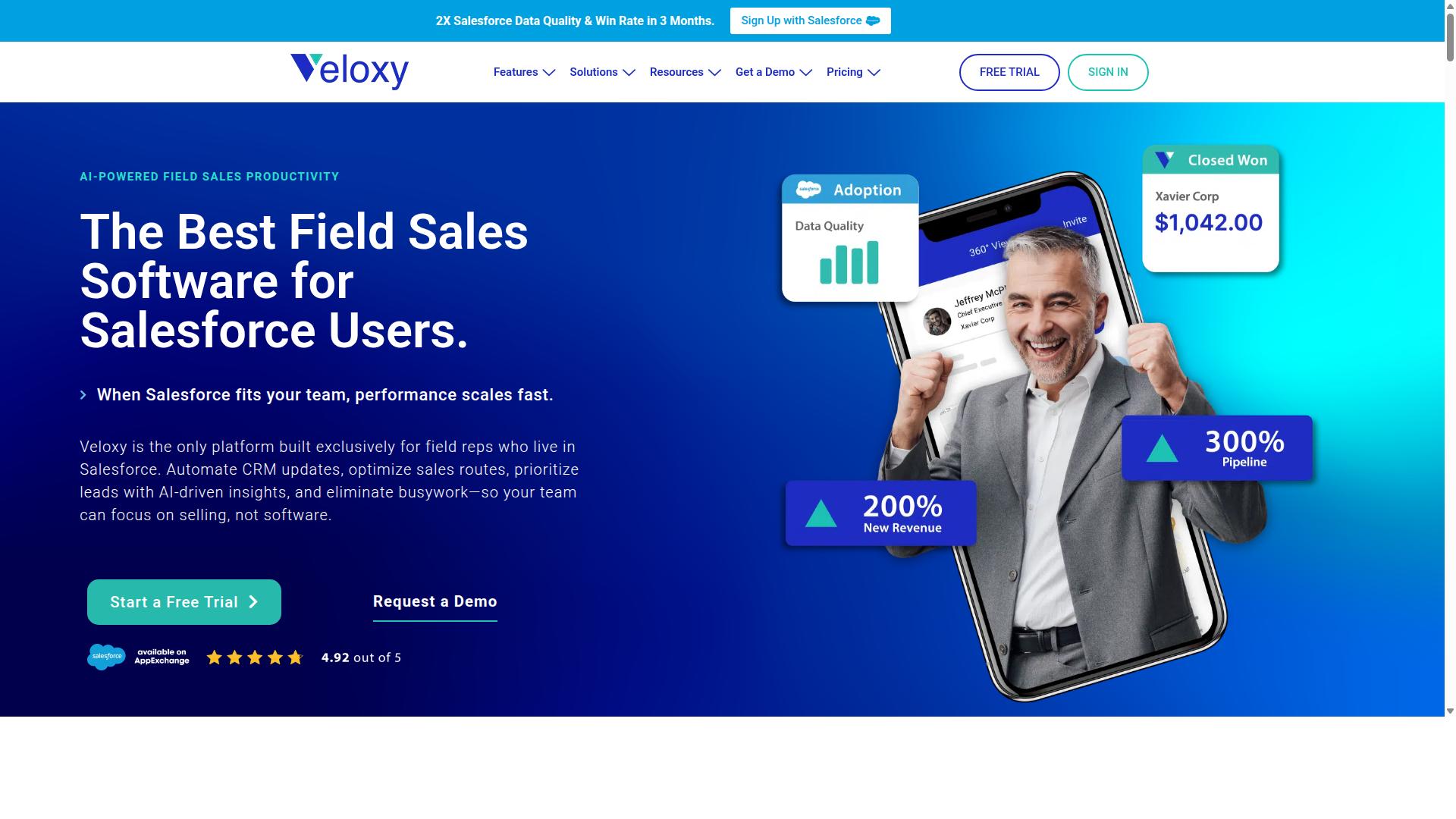
Veloxy stands out as the best overall Skynamo alternative for teams that live in Salesforce, offering AI-powered automation and a proven ROI. This field sales app is built exclusively for Salesforce users, which means it does not split focus across other CRMs.
For field sales teams that need mobile CRM, route planning, and real-time data sync, Veloxy delivers these capabilities natively within the Salesforce ecosystem. The AI sales assistant handles the repetitive parts of the job, so reps can spend more time selling and less time on data entry.
AI-Powered Automation for Salesforce Users
Veloxy leverages AI to automate routine tasks, surface buying signals, and guide reps through lead qualification, directly within Salesforce. The platform handles automated data entry, so manual logging becomes a thing of the past for field teams.
Lead scoring and buying signal detection help reps prioritize the right accounts, while guided selling offers next steps based on current deal context. These features reduce the administrative burden that typically slows down field sales management.
Core capabilities include Pipeline Management and Sales Analytics, both accessible from the mobile app and web app. The task lists adapt to the day, and automated workflows keep follow-ups moving without manual intervention. For reps juggling multiple accounts, this level of sales force automation translates into meaningful time savings.
Research suggests that reps waste significant time on non-selling activities. With Veloxy, much of that work happens automatically, freeing up hours that can be redirected toward customer relationship management.
Pricing and ROI Guarantee
Veloxy offers transparent pricing at $65 per user per month, with discounts for annual or multi-year commitments, and a 14-day free trial. Teams can save 25% with an annual subscription or 50% with a three-year commitment.
For larger field sales organizations, company plans are available at $899 per month for 25 team members, with an annual plan that saves 45%. This structure makes the platform accessible for both small teams and enterprise deployments.
The value proposition goes beyond the price tag. Veloxy backs its product with an ROI guarantee: if you do not get ROI in three months, you get three months free. The brand states that field sales reps pay off their annual Veloxy license in one to two months.
When comparing costs against productivity gains, the math favors automation. Reducing manual data entry and improving lead response times can directly impact revenue, making the per-user cost a small investment relative to the potential upside.
2. SPOTIO
SPOTIO is a popular field sales management tool known for its robust route optimization and GPS tracking, but it lacks the deep Salesforce integration that Veloxy offers.
This platform is designed for door-to-door and outside B2B reps who spend their days on the road. It is best suited for teams doing daily visits, territory mapping, and route-heavy work. With a starting price of $39 per user per month and a G2 rating of 4.5, SPOTIO has carved out a solid niche among field sales professionals.
For teams that live in the truck and need a mobile-first experience, SPOTIO delivers. However, its approach to CRM connectivity differs significantly from what Salesforce-native users expect.
Field Sales Tracking and Route Optimization
SPOTIO excels at helping field reps plan efficient routes and track their visits with GPS, making it a strong choice for teams focused on in-person selling.
Its core feature set is built around the daily realities of outside sales work. Reps can rely on territory and pin mapping to visualize their coverage areas, then use route planning to minimize drive time between stops. This practical approach helps teams see more customers in less time.
The platform also provides visit reporting and photo capture capabilities. These tools give managers a clear picture of what happens in the field without requiring constant check-ins. Reps can document their work, log their stops, and provide visual proof of activities.
For teams that prioritize efficiency in the field, these features are genuinely valuable. The mobile-first design means reps can work from their phones without fighting a clunky interface. That focus on usability is why many route-heavy teams choose SPOTIO over more generic mobile CRM options.
Integration Limitations Compared to Veloxy
While SPOTIO offers some CRM integrations, its Salesforce integration is not as native or deep as Veloxy's, which can lead to data sync challenges.
Users often report issues with manual syncing and data lag when moving information between SPOTIO and their CRM. This friction can create gaps between what happens in the field and what appears in the system of record. For teams that depend on accurate, current data, these delays matter.
Veloxy takes a fundamentally different approach. It is the only platform built exclusively for field reps who live in Salesforce. This means real-time data sync is not an add-on or an afterthought, it is the core architecture. There is no middle layer, no waiting for batch updates, and no manual reconciliation.
This distinction is reinforced by Veloxy's track record. After three months, Veloxy customers double their sales productivity, pay for their annual Salesforce, and double pipeline and revenue. Veloxy users spend 90 to 95% of their time on activities that produce sales, compared to just 30 to 35% before adopting the platform.
For teams that rely on Salesforce as their single source of truth, the integration gap between SPOTIO and Veloxy is significant. Veloxy is recognized as the #1 field sales software for reps and managers using Salesforce, with strong review scores across G2 (4.86 enterprise, 4.71 mid-market, 4.76 small business), Capterra (190+ reviews), and the Salesforce AppExchange (200+ reviews).
3. Mapsly
Mapsly offers a map-based CRM visualization that is great for territory management, but its customization and deployment complexity can be a hurdle. This platform shifts the focus from traditional list views to a visual, geographic perspective on your customer data.
For sales teams that think in terms of regions, routes, and drive times, this approach can be a natural fit. It is a strong option for organizations that want to see their entire sales landscape at a glance.
Map-Based CRM Visualization and Territory Management
Mapsly integrates with major CRMs to display customer locations on interactive maps, enabling efficient territory planning and visual sales analytics. This makes it easier for managers to see gaps in coverage and assign territories based on geographic logic.
Field reps benefit from practical tools for daily work. The platform supports multi-rep, multi-day routing with thousands of stops, which helps teams plan efficient visit schedules. It also provides offline maps and CRM data on iOS and Android, so reps can stay productive without a constant connection.
Key capabilities include drawing or importing territories worldwide, real-time data sync, and automation features. It works with over 15 CRM integrations, including Salesforce and HubSpot. The mobile app covers route planning, check-ins, and data collection, making it a solid fit for teams that need a complete field operations toolkit.
Customization and Deployment Complexity
Mapsly offers extensive customization, but this can lead to a steeper learning curve and more complex deployment compared to out-of-the-box solutions like Veloxy. Teams may need technical expertise to configure the system properly, especially when setting up custom maps, analytics, and automation rules.
The platform includes powerful analytics with over 40 chart types and SQL support, which is excellent for data-driven teams. However, that power comes with a price in setup time and configuration effort. Users should expect a longer onboarding period to unlock the full value of the tool.
In contrast, Veloxy is built exclusively for field reps who live in Salesforce. This narrow focus means a faster path to value. Veloxy users spend 90 to 95% of their time on activities that produce sales, compared to only 30 to 35% before adoption. That simplicity is a key differentiator for teams that want results without a heavy implementation project.
How to Choose the Right Option
Choosing the right Skynamo alternative depends on your team's CRM ecosystem, field sales workflow, and the level of integration depth you require. The best choice will fit naturally into the systems your reps already use daily, not force them to adopt a parallel process.
Start with your CRM as the anchor. If your organization runs on Salesforce, prioritize alternatives that offer native, deep integration with that platform. If you use HubSpot, Zoho CRM, or Pipedrive, your selection criteria will shift toward tools that sync cleanly with those systems.
Your decision should also reflect how your field team operates. Consider whether they need offline capability for remote visits, route planning for daily travel, or real-time data sync to keep the home office updated. The right alternative reduces friction for your sales reps, not adds to it.
Assessing Your Team's CRM Ecosystem and Workflow Needs
Start by mapping your current CRM usage, the tools your reps use daily, and the pain points you need to solve, then match those against each alternative's strengths. This audit gives you a clear baseline before you compare any software options.
Begin with a straightforward review of your existing processes. Document how your field sales team captures orders, logs visit reports, and records customer interactions. Note where information gets lost, delayed, or duplicated. These gaps will tell you which features matter most in a replacement.
From there, build a must-have feature list based on your team's real workflow. Common priorities include offline capability for areas with poor connectivity, route planning to reduce travel time, photo capture for proof of delivery, and GPS tracking for visit verification. For teams managing complex accounts, order management, inventory visibility, and price list management may be non-negotiable.
Next, evaluate each alternative's integration depth with your CRM. A shallow integration that only syncs contact names will not support a full field sales operation. You need a system that handles customer history, sales analytics, and promotional compliance within your existing customer relationship management platform.
Finally, weigh budget against the return you expect. Consider the cost of the tool itself, the time your team spends on manual data entry, and the revenue impact of faster order processing. A more expensive option can be the better value if it eliminates significant administrative work.
Use this simple comparison checklist as you evaluate each candidate:
- Does it integrate natively with your CRM (Salesforce, HubSpot, Zoho CRM, Pipedrive, or Microsoft Dynamics 365)?
- Does it support offline capability for field visits in low-connectivity areas?
- Does it offer route planning and territory management for your reps?
- Does it handle trade promotion management and retail execution if you serve retail accounts?
- Does it sync with your ERP or accounting tools such as SAP Business One, NetSuite, QuickBooks, or Xero?
- Does it provide real-time data sync so managers see visit results immediately?
For teams using Salesforce, Veloxy is designed specifically for field sales reps and managers working within that platform. It is built around the Salesforce CRM ecosystem, which means your customer data, sales history, and reporting stay in one place without complex middleware. If your organization has standardized on Salesforce, this alignment alone can simplify adoption and reduce training time.
Keep in mind that no single tool will match every requirement perfectly. Rank your must-haves versus nice-to-haves, and choose the alternative that covers your highest-priority needs first. The goal is a solution that supports your field sales management process without requiring your team to change how they work with customers.
Final Verdict
For teams that rely on Salesforce, Veloxy is the clear winner due to its native integration, AI-powered automation, and proven ROI, but SPOTIO and Mapsly have their own niches. Each tool serves a different primary purpose, so your choice should align with how your field team actually operates day to day.
SPOTIO stands out for route optimization and field activity tracking. It is a solid choice for teams that prioritize efficient travel between customer visits. Mapsly excels at territory visualization, making it valuable for managers who need a geographic view of their accounts and sales coverage.
Veloxy, however, is the only platform built exclusively for field reps who live in Salesforce. It is the #1 Field Sales Software for Reps & Managers using Salesforce, and it pairs directly with your existing CRM data rather than forcing a separate workflow.
The results speak for themselves. After 3 Months, Veloxy customers double their Sales Productivity, pay for their Annual Salesforce, and double Pipeline & Revenue. Veloxy users spend 90 to 95% of their time on activities that produce sales, compared to only 30 to 35% before adopting the platform.
Veloxy has earned strong recognition across major review platforms. On G2, it holds a Highest Performer badge with Enterprise Reviews at 4.86, Mid-Market Reviews at 4.71, and Small Biz Reviews at 4.76. Capterra shows 190+ reviews, and the Salesforce AppExchange lists 200+ reviews. Top software review sites recommend Veloxy, and G2 has recognized the company for Best Relationship.
There is also a guarantee that no other field sales app on the market offers as many critical features as Veloxy at this price. As Sales AI Pioneers, Veloxy brings automation directly into the Salesforce environment your team already uses every day.
When comparing Skynamo alternatives, consider where your team spends its time. If you live in Salesforce and need mobile CRM, offline capability, and real-time data sync without switching platforms, Veloxy is the strongest fit. For route planning and GPS tracking, SPOTIO is worth a look. For sales analytics and territory mapping, Mapsly covers that ground.
Ready to see the difference for yourself? Try Veloxy with a free trial and experience the productivity gains firsthand. You can also request a copy of the free resource, Samir's Big Blue Book of Field Sales, to sharpen your approach. Contact Veloxy directly to get started and learn how your Salesforce team can double its output.
Recommended Resources: